Sunday, May 31, 2009

Je suis retourné- the Regt. de Condé and some KK counters

Those of you who check any of my blogs from time to time undoubtedly realize by now that I have the attention span of an inebriated moth with a memory disorder.

For good or ill I have always had an interest in many different eras in both wargaming and in history in general, and it often happens that I drift off to some new or continuing project or another. In this case, I have been working on a WW1 project set in Italy, and have been working on a large terrain piece as well as a selection of French and Austro-Hungarians.


But this prodigal son always seems to return, sooner or later, to the eighteenth century and the spectacle of lace, tricorns, and the dandified elegance of the French army. So here is a lengthy post to mark the return of the Marquis to my attentions.

Aside from wanting a change from painting field grey and mud, two events are lurking on the horizon that indicate a return to the War of the Austrian Succession is in order. The first is the imminent, if now once-delayed, release of the latest edition of the
Koenig Krieg rules. And very nice they are too, if the teasers on the website's forum are anything to go by.

The other is the impending publication of a reprint of Sir Reginald Savory's
His Britannic Majesty's Army in the Seven Years' War, a project masterminded by Nigel Billington. While postdating the War of the Austrian Succession, it is well within my sphere of interest, and I am really excited to be able to get my hands on a copy. The last time I read it was back in university, and there is no other comparable work out there on the western theatre of the war.

So, with all this in mind I was happy to have had the time this week to take out some of my Front Rank French, clean then up and give them a coat of primer, and then get to work. I've stared on the 2nd Battalion of the
Regt. de Condé.


Twelve figures strong, Koenig Krieg battalions are piddlingly small when compared to this, but given space restrictions and the excruciating time it takes me to paint, units of twelve miniatures are more manageable for me.

Anyhow it is the brigade that is the focus of KK, and a brigade or three of these on the table will still look impressive.

The mini standing on the left is completed. I always do a "test" figure first as that way I can find out what I shouldn't do before I have to end up repainting a whole unit, or realizing that I could have saved time and tears if I had painted some parts of the mini in reversed order.

With these figures I found out that it really is easier to start with a black undercoat for all but the justeaucorp, which is undercoated in Ceramcoat's Bridgeport Grey before being highlighted in Soft Grey.

And it really helps to do the face first. I've always left it close to last before, and realize now that this was a
big mistake.

Part of the Auvergne brigade in my semi-fictional l'
Armée de l'Oise, the Regt. de Condé was unique for having it's drummers wear chamois coats with red facings and carmine lace that was the livery of the Condé family, rather than being dressed in the more familiar blue of the Kings' livery.  They were a very powerful family of great repute, so no doubt they could get away with it!

The guy in black skulking around the rear of the photo is a dismounted hussar, to be painted as one of the
Hussards de Sarkozy who will be part of a command stand. My miniatures when in the middle of painting always tend to look so demoralizingly messed up, and these are no exception. I'm a slow painter, but I have to say that these are proving very enjoyable to paint- at least once they begin looking like the one on the left!

It has become very obvious that it will take a long time indeed to finish even a brigade. I have decided that I will need either to outsource the lion's share of the painting, or to purchase some painted minis from eBay and touch them up rather than start from scratch. Considering that I need to work on the Pragmatic Army as well, this is really the only way to go.

Not a cheap option, and this will all have to be done in increments, but the problem is that I want to get gaming soon. The answer is to do what the old rule set The Complete Brigadier did. The rules, from way back in 1985 or earlier, came in an attractive box complete with cardboard counters that one could use while the army was being built up.

Yeah, I know, why not just play boardgames then? But I am a miniatures gamer at heart, and the idea of attractively coloured counters is as least as appealing visually as is a table full of unpainted minis, so I sat down at the computer and created some sets of counters using PowerPoint.

Here are some examples. Click on them for a larger view.
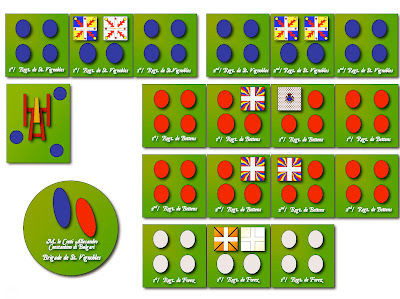


Brigade de St. Vignobles

Brigade d'Auvergne


I made a set of counters for each brigade of l'Armée de l'Oise. Next I'll work on the units for the Allies. The counters are actual-sized, and just need to be printed out, mounted on card, cut out and laminated. They can also be used as blinds for the game later once they are taken "out of the line" to be replaced with miniatures.  


Friday, January 2, 2009

The Missing Mouillard


Late 19th C. manuscript displaying a montage of regiments and uniforms including that of the Brigade de Bouillon-Cantinat, along with a miniature of its commander, The Chevalier de St. Estampie-Galliard, when the brigade formed part of the French Army of the L'Oise in 1743.

This immaculately-preserved artifact was brought to our attention by the noted expert on 18th C. French military uniforms, M. Lucien Rossignol.

Discovered amongst the Sangfroid papers in the collection of
La Bibliothèque Nationale de la Lorraine, it is remarkable for being the only example extant showing the uniform for the cavalry regiment Bouillon-Cantinat, and is the sole surviving fragment of plates from the 1892 limited edition of the Lucien Mouillard work, all copies of which were believed to have been destroyed in the shelling of L'Abbe de St. Vignobles during the campaign for Verdun in 1916.

It represents a very notable addition to our current knowledge of the French army of the War of the Austrian Succession.

The continuing tale of the Chevalier de St. Estampie-Galliard from the pen of his commanding officer, M. le Marquis de Sangfroid himself;

********

"After a few more fortifying glasses of claret, I felt myself able to explain to my confidant M. de Brouillier the reason that lay behind my apparent change of mood, and told him of what I knew of M. le Chevalier de St. Estampie-Galliard, the relating of which would certainly enlighten him to the source of my present distress.

The family of St. Estampie-Galliard is an ancient one from the lands of Roussilon, and while, of course, not of such august a lineage as that of the Bouillon-Cantinats, their service goes back many generations to the time of the Angevins.

The chevalier's father was of a man of some renown in the late wars in Spain alongside the great Marshal Berwick, in the course of which he met his future wife, the present chevalier's mother. She was a lady of ancient noble Spanish blood, who was renowned in her youth for her passionate nature and great beauty- as well as, it is said, for her somewhat lax moral character; a trait which, it must be noted, has evidently been passed on down to her son.

The chevalier is reputed to be quite handsome, and to his merit he is a fine rider and judge of horseflesh. Of his courage there is no doubt. Alas, the same cannot be said of his providence, perseverance nor especially of his judgement as it pertains to matters of a non-equine nature.

I had the opportunity once to conduct mass wherein the good chevalier was in attendance. The occasion remains in my remembrance on account of noting his frequent lack of concentration, consistent and loud yawning, and his insistence of taking up of conversation with the more attractive ladies of the congregation during my remonstrance against the evils of indolence and gluttony.

His good looks, athletic prowess, and considerable charm have served to further him in his career where otherwise his lack of mental agility and self-discipline would have disbarred him. Of late he had been serving in the Maison du Roi, with the Gendarmes Bourguignons du Roi. But evidently he has been showing fealty more to the Goddess Venus than to warlike Mars, which seems to have been the root cause for his current lack of employment.

It is reported, amongst those who have a taste for such snippets of knowledge and rumours, that the aged but most revered and influential of chancellors, M. le Duc du Cressé-Armagnac, had a very young and beautiful ward who was known to be a favourite of our King Louis.

Mlle. Hortense-Desirée de la Cloche-Rohan enjoyed a reputation throughout the court at Versailles for being a gentlewoman of singular beauty of complexion and fullness of figure, and she was much admired by the men of court, young and old. Thus when the opportunity arose, during the course of a dinner given in honour of the Conte d'Arles, it was upon this young enchantress who had evidently captured his attentions that our chevalier was to ply all the considerable talents for wooing and of charm that he had at his disposal."

"It appears that the chevalier's first real campaign was crowned with success and that the object of his besiegement surrendered the citadel- and all its more intimate chambers- without demur. Unfortunately for M. Le Chevalier, he was discovered engrossed in the act of intense exploration of his newly-conquered possessions by the Duke himself, who had descended into the wine cellar in company along with his companions, M. l'Abbe d'Eu and M. le Marquis de Feltres- who also happened to be the commanding officer of the Gendarmes Bourguignons du Roi-, intending to surprise these respected gentlemen with a cache of fine wines, which he had had the fortune to acquire in the course of a recent journey to Dijon.

That it was indeed a surprise to all involved is not in dispute.

The resulting fracas saw the benevolence and serenity of His Majesty sorely tested to the fullest, and it is rumoured that were it not for the timely intervention of the Queen- who had taken a liking to our now somewhat compromised hero- the worthy chevalier may by now have found himself in the service of the Ministry of Marine in New France. Instead, it was determined that he would be sent far from the centre of court to the armies currently serving on the frontiers either of the Rhine or of Piedmont-Savoy, in order that he may have to chance to redeem himself with his monarch through some act of heroism or other.

So it can be seen that Lady Chance is a fickle mistress, and thus it had fallen to my lot to provide a station in life for this unfortunate wastrel.

As the day went on, the thought of entrusting such a fine brigade of horse to a man of so little proven ability in matters of administration and tactics troubled my staff and I immeasurably. While no doubt ultimately having to accept the appointment, I determined that I would lever certain advantages from the arrangement.

Namely, I wanted a trusted second-in-command for the brigade, so I petitioned the Minister that I have the Regt. de Bouillon-Cantinat take precedence over the other regiments of the brigade, by recognizing it as a legitimate successor to its forbears in 1688.

Thus the brigade would bear it's name, and the major of the Regt. de Bouillon-Cantinat- my trusted and experienced subordinate from St. Vignobles itself, M. le Chevalier Eduard Duchamps de Botte-en-Selle- would through his position as brigade chief-of-staff prevent the Chevalier d'Estampie-Galliard from ruining the brigade through either neglect or excess.

The minister was only too glad to oblige to such terms, being thankful of having such a tedious conundrum removed from his hands. As for the chefs of the regiments of Clermont and of Conti, they showed themselves quite understanding of the situation, and in exchange for a few barrels of the choicest reserve cognacs from the wineries of St. Vignobles as well as the writing off of certain debts they had owing to me in the course of some ill-fated games of chance, they were content to acquiesce to such an extraordinary departure from the rules of precedence for the sake of the betterment and security of the Service."


Vexations from Versailles...


"As the summer turned into autumn in that eventful year of 1743, we laboured ceaselessly on forging l'armee de l'Oise, seeking through our efforts to sharpen it into a finely-honed foil with which to lunge at the King's enemies.

To that end, I was ever involved in seemingly endless cycles of correspondence with Versailles concerning the outfitting, victualling, and financing of the army, and furthermore found myself deep in a constant inundation of letters of introduction and and recommendations. We were subject to a veritable tide of candidates, great and humble, all hoping to be selected for posts of honour and responsibility as general and regimental officers.

I was determined to officer my corps with men that had shown aptitude & talent in the Profession of Mars, and who were well-versed in the social graces and of good family. In short, such gentlemen who would bring us honour and help to eradicate the shame that was Dettingen.

But we live in a world in which power, politics, and influence are unbounded. While I was on many occasion able to secure the services of worthy and dedicated individuals that would do us credit on the field, in other circumstances I was not always as fortunate. Oft was I compelled to walk a fine line and to broker agreements or compromises. And at times, composing myself with the resignation necessary in one who frequents the gaming table, I had just to accept the inevitable hand that fate (in the person of His Majesty) had dealt me.

Such a one was
M. Le Chevalier Raymond Boniface de St. Estampie-Galliard.

One morning as I was in the company of my comrade-in-arms, M. de Debrouillier, and with whom I was sharing a half-bottle of claret and quiche as a quick breakfast before making our customary inspections, we were disturbed from our deliberations by the arrival of a
post-chaise bearing a hefty packet of correspondence from Versailles.

Steadily going through the voluminous pile of envelopes contained within- being for the most part a collection of requests for receipts, notices of accounts payable, & provisioning letters-of-credit along with other such sundry matters of administration- I was dismayed to discover a missive closed with the heavy and ornate seal which marked the sender as being the esteemed- and most influential- Minister of War,
M. Marc-Pierre de Voyer de Paulmy, Comte d'Argenson.

I opened and read the letter with some apprehension. The essential contents of which, thereof, the Good Count- after proffering the best of wishes for my welfare and for my continued robust health- was pleased to inform me that His Majesty had tendered the "suggestion" that I take on the services of the said knight,
M. Le Chevalier Raymond Boniface de St. Estampie-Galliard. Who, I was assured, would render me honourable and energetic service if given the opportunity to command a brigade of horse.

Now such a recommendation carried with it the weight of Mighty Jove, and, having already used up considerable credit with the authorities in Versailles in my efforts to obtain the services of my new Quartermaster-General, M.
le chevalier Gouvrement de la Taille, I quickly calculated with sinking hope that this would be one appointment for which I would have to graciously submit to the benevolence and will of His Majesty.

Well able to ascertain my sudden and considerable feelings of vexation, M. de Debrouiller at once poured me another glass of claret, and inquired solicitously of the source of my evident and wholly unexpected chagrin."


Cont.


Tuesday, December 30, 2008

Sarkozy's Pandours- or, some "pocket money" for M. le Marquis...

Another template courtesy of "Not by Appointment" !

"During the lengthy process of retraining and refitting l'armee de l'Oise at Thionville, it was necessary to keep the enemy from looking to our frontier with an eye for mischief all the time that the defences of France were at at such a nadir. It was imperative to prevent the forces of the Pragmatic Alliance from taking advantage of our current deplorable state, and, if possible, to deceive them as to the true extent of our discomfiture.

For this service, we needed men of energy and enterprise, and we had no further to look for such hearty individuals than in our new band of hussars and their
chef, Count Horthy Emil Sarkozy.

The Count soon demonstrated the wisdom of our having accepted his services, for no sooner had he joined our camp, than he began a series of raids, moonlight strikes, bluffs and other activities all along the part of the frontier that seperated the two armies.

It was quite remarkable to us officers, our being so used to conditions of service with the French army, with what little fanfare Count Sarkozy and his hussars would make their departure. Leaving in the early hours before sunrise, no sooner would they ride out of the camp than they would seemingly vanish into the very ether; burdened neither by train nor baggage, other than what the men could strap to their horses.

We would hear no news of them for days at a time. And then, with no harbinger or rumour heralding their approach, they would just as suddenly reappear, with no more ceremony as would have been the case had they merely been out on a morning to exercise their mounts.

Upon his return, Count Sarkozy would first attend to watering his horses and to obtaining food for his men. He would then directly make his way to my quarters, s
till covered in the accumulated grime of his latest adventure, where after brusquely paying his respects to the assembled company, he would then commence to present me with his latest souvenirs; a chest of maps here, some intelligence on enemy forces there, and even from time to time a valuable prisoner. (This included on one occasion none other than Graf Kristoph von Meissenplatz- a celebrated officer late in the service of the Duke of Hesse-Rheingelden- in whose company I then had the pleasure to dine.)

And always, Sarkozy's hussars- both men and horses- would return burdened with chests of coin, jewelry, and sacks of gold and other valuables, so that they were soon as rich as corsairs.


Which was as well, as in time I found myself in a position to bankroll the army and to pay for proper equipment and provisioning. A soldier may fight for honour or his comrades, but an army marches, alas, on money. My headaches at the time from dealing with the parsimonious scrubs in the Ministry of War were at their worst, and financing was always in short supply in those days.

I therefore did not press the Count too closely on how or where these most likely ill-gotten gains originated, but in my capacity as Prince Ecclesiastical of the Bishopric of St. Vignobles, I was always sure to give a brief benediction at Mass for those souls who may have had to endure the suffering that can befall the lot of those who have been privileged to "contribute" to the cause of Good King Louis.

Also long-suffering indeed was the Conte d'Aglianico, a most brave and professional lieutenant of mine, under whose direct command Sarkozy found himself (inasmuch as our wild Hungarian deigned submit to our command; or indeed, to any authority at all).

Many were the times that this gallant officer was called upon to intervene in the constant stream of disputes that arose between Sarkozy's band of uniformed brigands and the local populace. Through the judicious application of honeyed words, favours, bribes -and, when necessary, dark threats- he accomplished minor marvels of diplomacy, shielding me, along with the rest of my overburdened staff, from the endless deputations of affronted local counsellors and other such disaffected citizenry.


Nonetheless, it was acknowledged by all that the value of Sarkozy's actions against the enemy were proving their worth, and he soon developed a fearsome reputation on the far bank of the Rhine. Captured documents revealed that the enemy were having to send additional forces to meet the threat. Indeed, none other than the esteemed M. de Saxe was soon to write to me and to the War Ministry, asking that the raids continue as they were serving to draw reinforcements away from the Flanders theatre that would otherwise be ranged against him in his upcoming campaign there.

The proposal was soon made that Sarkozy's band be increased by the recruiting of two extra squadrons of hussars to that of a full regiment, and that a unit of Pandours be raised. These latter to be recruited from prisoners taken in recent actions in Bavaria- men whose dedication to the Habsburg crown was considered to have taken less of a hold on their hearts than did the prospect of a full purse while serving under the illustrious, and increasingly renowned, Count Sarkozy."

Monday, December 29, 2008

The Sarkozy Hussars

click on image to enlarge.

In
the words of
M. le Marquis...


"As the French army licked its grievous wounds after the Battle of Dettingen at the newly-constructed camp at Thionville, our time was often taken up with the routine work of training and outfitting the army so that it would once again be fit to stand in the line of battle.

One warm August morning, I found myself returning from my daily hunt along with my staff, and in the midst of a lively discussion on where one could best obtain the finest truffles, when suddenly we ventured upon a remarkable sight. Riding up the road ahead of us was a rather villainous-looking band of ragged ruffians, led by one of the most fierce, feral-looking individuals upon which I have ever cast my eyes.

Yet I was struck by a pride and spirit that was evident in their hardened countenances and which impressed me, a pride which had been so dearly lacking in our men since that dreadful day by the River Main.


Count Horthy Emil Sarkozy, in the uniform of his former regiment
(when in the employ of Her Highness the Empress
)


This band of apparent brigands was led by none other than
Count Horthy Emil Sarkozy, a noblemen descended from an ancient House with lands in the eastern reaches of The Empress of Austria's domains. A disciple of the great Baron Trenck, his reputation for cunning, cruelty, and the pursuit of riches was known by all, but there was no greater nor more energetic leader of troops for conducting le petite guerre west of the mountains of Bohemia. He and his men were legendary for being most provident and enterprising masters of their terrible trade.

It transpired that when in service with the Pragmatic Army in the campaigns in Bavaria, he and Baron Trenck had found themselves embroiled in a bitter altercation over the apportioning of some considerable booty, and nearly came to blows; indeed, Sarkozy in his fury fired a shot at the Baron. The bullet, whilst missing its intended target, went on to hit and to wound mortally the nearby young Margrave of Groelchenburg, a close cousin and a favourite of Her Majesty.

Naturally, this act endeared the Count neither
with Marshal Konigsegg nor with the House of Habsburg generally. Within days, Sarkozy found himself being strongly urged, by those of his associates who had close connections with the court in Vienna, that it would be in his best interests to flee the service of the Empress Queen.

One moonless night soon afterwards he rode out with his men to the Rhine frontier, crossing over to the west bank somewhere just north of Mainz after having successfully avoided the piquets on either side.

He later revealed that he had heard much about my exploits at the Bridge of Seligenstadt- and that I was well-known for keeping a lavish table well-provisioned with fine wines from the family estates at St. Vignobles- and that he had ridden to Thionville in order that he may offer me his services, along with those of his men.


I was touched both by his sincerity and by his martial demeanour, and duly petitioned the War Ministry. His offer was graciously accepted, and I was thus entreated and commissioned to outfit the men for the King's service.

I had a new uniform made for them in the Hungarian fashion, using the same bolts of grey and mulberry cloth that I had purchased to clothe the Regt. de Buillon-Cantinat. I also issued them with a standard- the ancient and faded guidon of the Bouillon-Cantinat Regiment of Gentlemen Volunteers, who had seen service in 1688 with the Great Louis and Turenne in their Wars in the Palatine.

Touched in turn by the sincerity and magnanimity of my gesture, Count Sarkozy swore tearfully that he and his men would honour the standard and would defend it to the last man. He then declared that all the time that he, Count Horthy Emil Sarkozy, had breath to draw in his body, he would champion the cause of France and the furtherance of the House of Bouillon-Cantinat."


Uniform plate based again on (the
indispensable) templates provided by David at "Not by Appointment". Thanks, David.

Sunday, December 28, 2008

L'Armee de l'Oise

C'est fini. Click to enlarge.


Update- I forget the grenadiers! Duly added- thanks to "Capt. Bill" for bringing their absence to my attention!

Introducing the Regiment de Bouillon-Cantinat


The
cavalry of
L’armée Française de l’Oise.

Brigade Colonel-General


  • Regt. Colonel-General
  • Regt. de la Reine
  • Regt. Dauphin
Brigade Bouillon-Cantinat
  • Regt. Bouillon-Cantinat
  • Regt. Conti
  • Regt. Clermont
Brigade Bauffremont (Dragoons)
  • Regt. Beauffremont
  • Regt. Harcourt
  • Regt. d'Aubigne
Troupes légère

  • les Hussards de Sarkozy (the Sarkozy Legion)
It is now high time to let the Marquis take over the narrative. From his memoirs;

"
The creation of L’armée de l’Oise was decreed after the disaster of Dettingen, and was to be formed from the debris and remnants of the French armies of Messieurs les Ducs de Grammont and de Noailles.

After Dettingen these worthy gentlemen found themselves recalled to Vesailles to give account of their failure to punish the Allies with the alacrity and completeness with which they had assured His Majesty was to have been the expected outcome.

It was myself, M. Le Marquis de Sangfroid, who on the departure of M. Grammont was given command of this new army.

I was duly tasked by the Ministry of War with the protection of the French side of the Rhine from any incursion by the Army of the Pragmatic Sanction, and when necessary to support the actions of the esteemed
M. le marechal de Saxe in his laudable campaigns in the Low Countries.

Those of the cavalry and infantry who managed to cross the Rhine in safety were reorganized in a new encampment that was set up at Thionville. The demoralized survivors of the cavalry were joined by the
Regt. Dauphin, and by the dragoon regiments Harcourt and Aubigne.

In time- and with care to drill, bellies, and purses- morale steadily improved.

The infantry regiments were brought back up to strength by drafts with which to replace their grievous losses, and were joined by the valiant men of the Regt. Royal Baviere.

Furthermore, and in recognition of my services to His Serene Majesty at Seligenstadt in which the valorous and noble conduct of the men of the Regt. de St. Vignobles was commented upon by all, I was commissioned to raise a new cavalry regiment from my estates in Artois and St. Vignobles, the Regt. de Bouillon-Cantinat.

Over the next few years, the army was trained by myself to a high standard of efficiency, as was noted with gracious pleasure by the esteemed Marechal de Saxe himself. In my trustworthy hands, L’armée de l’Oise was to bring considerable honour to France, to our beloved monarch, and to the prestige of the noble house of Bouillon-Cantinat."


*************

Renowned for it's imposing bearskins (a gift from Mme. la Duchesse de Richmonte in exchange for some -let us say, discrete- services on my part) as well as for its wine-red facings, the intrepid Regiment de Bouillon-Cantinat was to earn itself a reputation second to none for fearlessness in combat.

And, it must be admitted, a reputation to no small degree for licentiousness as well. This being as a result of frequent and oft-publicized forays to the local taverns and other houses of ill repute. In these nefarious activities, they were more often than not discovered to have been aided by their rather brigand-like comrades-in-arms, the Hussars of Sarkozy.

As a consequence of such mischief, on many an occasion
I was forced to make use of my influence & considerable charm- and, in some cases, of timely reminders upon debts payable from old games of chance- so as to prevent retribution being levied upon the men of the regiment by the heavy hands of local council authorities.


The Fanfare March of the Regt. de Bouillon-Cantinat

********

Click on the image to enlarge. Thanks, as always, to David of "Not by Appointment " for providing the uniform and flag templates.